

Dronestuff2
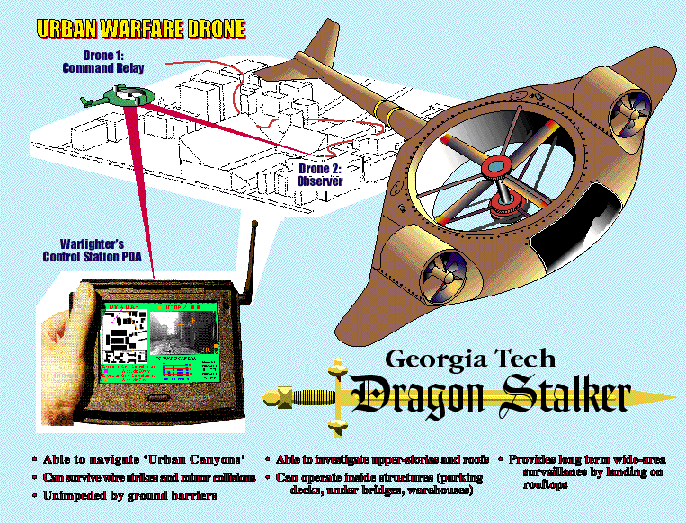
Page for info on the flying drone mine killer.
 Kill the mine not the people, "wage peace not war. Albert Einstein, R@wman.
    |


Land mine search ,Flying drone mine finder mapper,GSP<
Scientific American: News In Brief: Neutrons for Land
Mine Detection: October 30, 2000

Search 4 land mine @ Google:Search>http://images.google.com/images?num=20&hl=en&im
Disclaimer  DIRECTORY
DIRECTORY 
Ah but I digress ....
#4 The Real Patriotic Words of JFK
JFKAbout Robert C. Michelson's Drone Project
~~~~~~~~~~~~~~~~~~~~~~~~~~~~~~~~
Hi All FYI
RE: Drone project My idea is to use small swap able motor , plastic body
& a wankel motor ( they make small ones for bikes ) , or use a high tork
electric not motor sure yet .Be well
CM3 Landmine Survivors Rehabilitation Database - Landmine Affected ...
The United Nations Demining Database by United Nations The World Factbook by
Central Intelligence Agency The Worldwide Epidemic of Landmine Injuries: The ICRC ...


 Experts approximate that more than 110 million land mines--hidden disasters waiting to
 happen--are buried around the world in nearly 70 countries. And at the rate people are
currently working to find and remove these threats, the United Nations' Landmine
Database estimates the job will take another 1,100 years. Potential victims don't have
that long to wait, and so researchers at the Pacific Northwest National Laboratory have
come up with a new kind of land mine detector, the Timed Neutron Detector (right).
The device, which the scientists say should prove easier to use and more affordable than
current methods, was field-tested in September and will be presented by principal
investigator Richard Craig on November 14 in Washington, D.C., at the international
meeting of the American Nuclear Society and the European Nuclear Society.
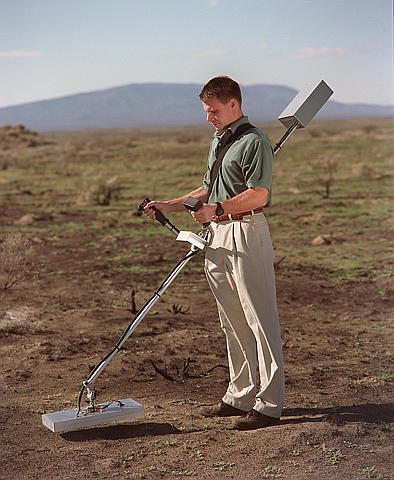
The instrument uses neutrons to pick up on hydrogen used in casings and
explosives found in both plastic and metal land mines.
A neutron source, about the size of a pager, holds a small amount of californium-252.
As the element decays, it emits neutrons, which electronics in the instrument then
"time tag," noting when the fission occurred.
The neutrons shoot out into the soil, where they lose energy if they interact with hydrogen
in a mine.
These less energetic, slow neutrons are reflected back toward the detector;
nonradioactive helium-3 in low-pressure pipes collects them and emits electrons.
By way of other circuitry, these electrons translate into the desired information:
whether a land mine was encountered or not. The scientists
say that a person operating the detector would not receive
any more radiation than if they were on a cross-country flight
. --Kristin Leutwyler

Links Links
here it is Date: 18 Oct 2001 00:11:20 -0700 From:
Cary Fisher sent these Links not all are Drone related
but all are interesting.
somewhere in the the ufo community site is a link to steve neil's site .
~~~~~~~~~~~~~~~~~~~~~~~~~~~~~~~~
Subject: Maybe we should...Date: Sat, 27 Oct 2001 09:31:32 EDT
wake up and smell the coffee before it's against the law. This is the legislation proposed or signed into law since 9/11.
elj
EL check this out http://www.moveon.org/beprepared/
Ten Alternative Responses to Terrorism Deborah Gerner and Philip Schrodt
Baldwin, Kansas contact: gerner@ku.edu, schrodt@ku.edu
PS: I would like to have a web page document with HTML hyper links in it
EL was there such a page can you sent it what format did you send
me did you copy an of a specific format ? Please e me at the regular address
Land Mine Hunter & Search @ Google FYI About Robert C. Michelson's Drone Projec
#1
Search Land Mine
#2
google search Drone
#3
Wankle Moror
****************************************************************
******************************
U.S. says its land mines aren't the problem
October 10, 1997
Web posted at: 9:37 p.m. EDT (0137 GMT)
WASHINGTON (CNN) -- The Clinton administration says the
award of the Nobel Peace Prize
to an anti-land mine organization does not change the argument that high-tech "smart mines" will be needed for at least a few more years to protect U.S. troops.
|
 |
"The president is absolutely rock-solid confident that he's got the right approach,"
said White House spokesman Mike McCurry.
McCurry said the United States favors eliminating land mines, which kill or maim an
estimated 26,000 people a year. But it wants leeway for using land mines in Korea until
an alternative weapon can be developed.
Jody Williams, who received the Peace Prize along with her group International Campaign to Ban Landmines, is critical of the president's position.
"I will ask him to reconsider his policy and explain it to me, 'cause I sure don't
understand it," she said. "He has abdicated his role as commander-in-chief and
let the military set foreign policy.
"I've repeatedly said that Bill Clinton is neither a leader nor a statesman and I'll
say it again," Williams said. "I hope this prize will help change his mind."
But the Pentagon insists that it is not part of the land mine problem,and that
beginning in 1992 it voluntarily eliminated from its arsenal the kind of mines
that maim and kill innocent civilians.
"We no longer deploy those land mines," said Pentagon spokesman Ken Bacon.
"We no longer make them, and we no longer export land mines of any sort."
Russia to sign treaty Nevertheless, the administration's position has isolated the
United States from the rest of the world community.
About 100 nations are expected to sign a treaty in December that calls for an
immediate and total ban on the export and use of anti-personnel land mines.
Russia, which did not taken part in the negotiations, announced Friday that it, too,
would sign the treaty.
James Rubin, another Pentagon spokesman, welcomed Russian President Boris
Yeltsin's decision, saying that the problem with the treaty is that it does not include
the biggest exporters of land mines,especially Russia and China.
The Clinton administration is particularly concerned about China,which is the world's
leading maker and exporter of land mines. China did not take part in the treaty talks,
either.
Meanwhile, U.S. commanders say they need so-called "smart mines" to protect
troops in battle and special forces on commando missions.
"Smart mines" are those which automatically de-activate after days or even hours --
and which the Pentagon claims have never harmed a civilian.
"They lay on the ground in plain view, and they really buy us some time," says
Army Brig. Gen. Larry Dodgen. "They buy us some time to eliminate the possibility
of surprise to U.S. forces on the battlefield, and also to push the enemy in a certain
direction that we want him to go in order to defeat him properly."
Land mines in Korea 'no real defense'
|
The Pentagon says that in South
American troops are stationed,
secured and marked mine fields
near the demilitarized zone form a
key part of the strategy for keeping
North Korea's million-man army at
bay.
The Pentagon estimates it force
would suffer 30 percent higher
casualties in a war on the Korean
peninsula without the land mine
barrier. But critics don't buy it.
|
Click Book to go to webpage
 |
"If the defense of South Korea depends primarily on land mines, then
that's no real defense,"
says U.S. Sen. Patrick Leahy, a Vermont Democrat.
The Pentagon argues that it has obligations around the world that make
the United States a special case.
"We have security responsibilities with other nations that far surpass
other nations on the earth," Dodgen said. "And when we are sending
our nation's sons and daughters out to do these particular missions, we
certainly ... owe it to the mothers and fathers that they have every
safeguard that they could possibly have."
U.S. spent $153 million to remove mines
The United States also claims to spend more on humanitarian
operations to remove land mines than any other nation in the world --
$153 million since 1993.
The Pentagon says that while it agrees with the goal of the Peace Prize
winners -- to rid the world of all anti-personnel mines -- it needs more
time to find other ways to protect U.S. troops.
As one officer put it, "I guess they figure that since the U.S. military
can beat anyone with one hand tied behind our back, we may as well
tie the other hand."
Correspondent Jamie McIntyre, The Associated Press and Reuters
contributed to this report.
************
October 30, 2000 http://www.sciam.com/news/103000/5.html
|
Friday, April 13, 2001 For some in Bosnia, springtime means time to find,
clear land mines By Adam Ramirez, Bosnia bureau
GRADACAC, Bosnia and
Herzegovina — Spring represents renewal, freshness
and optimism for most people.
But for those working in the fields of Bosnia, breaking the soil in the seasonal ritual is a hazardous undertaking.
That’s because the painstaking de-mining season starts
anew in April, and the harvest in the months to come looks too plentiful.
With more than 1 million mines still in the ground —
some estimates put that number much higher —
Bosnia leads the world in the number of mines per
square mile. Only about 16 miles of the estimated 248,000 square miles where mines were laid during the war have been cleared since 1998.
At that rate, American officials project that the work won’t be done for another 66 years — or about in 2067.
|
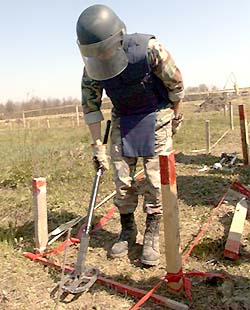 |
There are other obstacles. The Bosnians required to remove the mines
aren’t getting paid on time. They also work with subpar equipment, and
even that is in short supply. Still, officials at the Mine Action Center on
the United States’ Eagle Base are focused on safely clearing as much
land as possible.
And they can point to some success: About 36,000 mines have been
taken from the ground in the U.S. sector alone since 1997.
But there are constant reminders of the work left to be done.
"We just had another mine strike a few days ago —
you never know when they will hit," said American Army Capt. Steven Hayden
at the center.
Hayden defined a mine strike as a mine detonation the center is told about.
Sitting next to an enormous, room-sized map with
thousands of tiny red dots pinpointing minefields, Capt.
Daniel Kustelski said it’s hard to describe the enormity
of the project.
"It’s just mind-boggling if you look at how slow it
goes and how much has to be cleared," Kustelski said.
"The task is just too big to think of all that has to be
done. You have to think about [improvement] from
season to season and hope to improve things right
now."
Hayden said four main groups of workers clear
mines from April to November in Bosnia: Bosnian
military forces; civilian protection forces, such as
police; independent operators funded by
nongovernmental organizations; and independent
operators funded by the government.
The last two groups have been responsible
for clearing about 87 percent of the mines.
Stabilization Force spent about $11 million
last year funding commercial crews.
It’s not clear how much the various nongovernmental
agencies have spent.
Hayden said the independent operators have beenable to clear more ground because they use modern equipment and dog teams that allow them
to locate mines far quicker than the inch-by-inch poking method used by the Bosnian military.
Still, an estimated 350,000 mines remain in Multinational Division-North,
the American sector. That’s 350,000 too many for American Maj. Gen.Walter L. Sharp.
"The de-mining rate is my single biggest disappointment here," Sharp said."
We have hard-working people, but there’s not nearly enough of them and
they’re not properly equipped," he said.
"We’re pushing hard to get more mechanized machines and more dog teams to speed
up the process. People are getting killed."
Through Monday, four people had been killed by mines in the American
sector this year. In 2000, there were 13 fatal mine strikes.
While U.S. troops do not physically remove any mines, they do see
the stress and wear on the armed forces of Bosnian de-miners.
Those crews are paid by their government. The de-miner’s base salary is
often as much as three months late and hazardous pay is rarely included.
"We do our job and are proud to do it — the delay in our pay is just part of our
government. Everyone has to deal with it," Bosnian Sgt. Alija Mujic said while
working in a grassy minefield in Gradacac, northwest of Tuzla.
"I live in this village, so I sometimes think of making it safe for my 2-year-old
son and all the civilians around here."
The Bosnian government is still struggling financially. And clearing mines takes money. It costs an average of
$3 to produce a land mine and an average of $1,000 to clear it.
Morale among the de-miners is a top concern for officers such as Hayden,
who must monitor that procedures are followed and land is cleared according
to regulation.
"There’s been a lot of talk of the de-miners dropping their tools and going on
strike," he said. "Obviously, someone who is not getting paid on time isn’t
going to go above and beyond. Their bonus pay has been late the past two
seasons."
Some de-miners have quit their military posts to go to work for commercial
de-mining companies that offer better and steadier pay.
The rest of them doggedly continue their assignments.
"All my men are aware of the importance of their job," said Capt. Senad
Smigalovic. "We all feel a sense of pride that we are doing a valuable
thing here."
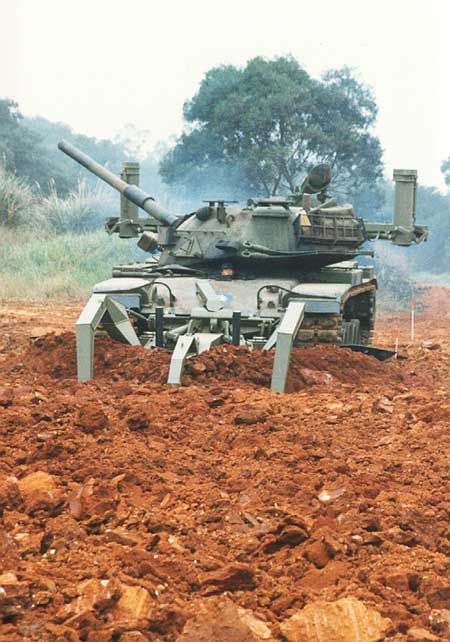
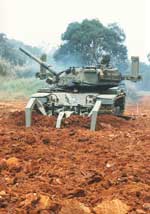
MINE CLEARANCE
M60 tanks have been fitted with mine clearance systems
for use in wartime and in post war periods of de-escalation
of hostilities for the reclamation of land for safe use.
The Pearson Engineer Mine plough contains a magnetic
signature device, the Demeter, to explode magneticall
influenced anti-tank mines ahead and to the side of the
vehicle. At each side at the rear of the M60 tank the
Pearson Pathfinder minefield marking system marks the
cleared safe lane.

