
 |
 |
|||
HCIG HidenFacts5 Home HCIG0 | HCIG.01-911 | hcigAmbush666 | HCIG2 | HCIG3 | HCIG4 | HCIG HidenFacts5
  |
||||
|
|
|||
Some Stuff From some Occult Web Link's  
|
|
|||

|
GEORGE W. BUSH, NEWS JUNKIE Issue of 2003-10-13 Posted 2003-10-06 Bush said he insulates himself from the “opinions” that seep into news coverage
by getting his news from his own aides. He said he scans headlines, but rarely
reads news stories. “I appreciate people’s opinions, but I’m more interested in
news,” the president said. “And the best way to get the news is from objective
sources, and the most objective sources I have are people on my staff who tell
me what’s happening in the world.”—The Associated Press, September 22.
8:10 a.m.: During a breakfast briefing in the Oval Office, Secretary of Defense
Donald H. Rumsfeld informed the President that, according to the Cibola County,
New Mexico, Beacon, members of the Cibola County 4-H performed well during
junior week at the New Mexico State Fair. After the President pressed him for more
details, Mr. Rumsfeld revealed that Cody Mirabal was named “reserve grand
champion” in the over-all swine category, besting four hundred and eighty of
the top hogs in the state. Mr. Rumsfeld agreed with Mr. Bush that Mr. Mirabal’s hog
must have been some hog.
3:49 p.m.: Joining the President on his afternoon jog, Secretary of Homeland
Security Tom Ridge briefed him on an article that appeared in the Chattanooga,
Tennessee, Times Free Press, reporting that a mustachioed man wearing a
flowered dress and a floppy hat attempted to rob a bank in Rome, Georgia, but
was apprehended soon afterward. Mr. Ridge agreed with the President that
robbing a bank with a mustache and a flowery dress on is a pretty stupid thing
to do, because it only makes you stand out. The President decided that no action
from the White House was necessary because the man had been caught.
9:57 p.m.: Shortly before the President’s bedtime, Vice-President Dick Cheney
arrived at the White House to read him the day’s installment of “Beetle Bailey,”
in the Washington Post. The Vice-President said that in the first panel of the strip
the character Sarge is dining at a fancy restaurant. A snooty waiter is holding a
wine bottle and asks Sarge, “Would you like to sniff the cork, sir?,” to which Sarge
replies, “Let me have it.” In the next (and last) panel, Sarge offers the cork to his
dog,Otto, and says, “I brought my professional sniffer.” The President said that
this was not a particularly good one, and asked the Vice- President what
happened in “Marmaduke.”
— Andy Borowitz
Charles,
I appreciate your sending this; one note of caution: in case any of your distribution list members are not familiar with Andy Borowitz,
he is a well known humorist, and the described Pres. Bush events in his article should not be taken literally or seriously. While I
found them quite amusing, someone not familiar with the author would likely come away with an altogether different and erroneous view. Best, Rich
What that Bush actually cares about what's happening and wants to "shield " himself from reality by making his staff sanitize the already doctored accounts of the world so as to be at peace with the decisions made by others in his name ?
|
It is the mark of an educated mind to be able to entertain a thought without
accepting it.~ Aristotle
This material is posted for educational use only, sorry if you find this material
offensive. It is a part of this web site and not meant as an endorsement or
incitement. See our Disclaimer If you have comments please contact the author
We feel it is necessary to see what others think or say they believe, it's presence on this
& other pages is hardly gratuitous... We do not necessarily agree with the points of view
found in the texts excerpted or on the links listed on this page, please read and & review
it, do the study to prove what is true and accurate.
Don't start with a partisan view try to find those views that may be totally contrary to your
beliefs and discuss and read whatever you can find. Use a library request they supply
the books you request so others can share them.
|
"He who rest on his or her laurels wears them in the wrong place."
~Anon
" Lay down with Bears Expect some Hairs".
~Anon
"Work is worship"
~A Shaker saying
"Breath is prayer"
~A Sufi saying
"If you can think it, you can say it, if say it you do it.
~"Advice from the Marquis De-Sad
"Your Race is what good YOU achieve YOUR philosophy IS what you do (just)
before you die." Anon
HCIG HidenFacts5
BLACK HEBREW ISRAELITESBlack Hebrews?
The very words cause many people to grin at what appears to be simply a play on
words. No one reads about such people in European authored history books and
there are only a few references to "Ethiopian Jews" in white Jewish sources.
Yet Black Hebrews have existed since biblical times. In fact, they are the original
or proto-typical Hebrews.
Their story begins with the Patriarch Abraham (2117-1942 B.C.), a native of the
Sumerian city of Ur in ancient Mesopotamia. [present day Iraq Ed.]
Archaeological discoveries have proven that the earliest inhabitants of southern
Mesopotamia were members of the "Brown Race," i.e., the Negroid branch of
humanity.
It has been confirmed that the ancient Sumerians were akin to the modern Black
Dravidians of India.
The Sumerians also had an affinity with a people known as the Elamites, the very
first Semitic group mentioned in the Bible (Gen. 10:22). The Elamites were a black-
skinned and woolly-haired people as the colorful glazed artwork on the royal palace
walls of the ancient Persian city of Susa clearly show.
Thus Abraham, the native of Sumeria and the founding father of
the Israelite nation, was a black man.
The black racial origins of the Patriarchs is not based on mere
conjecture, it is in complete agreement with the picture one gets
from examining the identity of the earliest inhabitants of southern
Mesopotamia.
This truth is grossly neglected, suppressed, and distorted in most European
and American historical texts which are flavored with race prejudice.
Fortunately, however, there are enough well authored and highly researched works
by Black historians that challenge the Eurocentric revisions of history and correct
the various erroneous views regarding the ethnic identity of the Hebrews.
Biblical history relates that the descendants of Abraham, namely Jacob (Israel) and
his twelve sons and their wives, 70 in all, migrated from Canaan to Egypt around the
year 1827 B.C. During their sojourn in Egypt the Children of Israel multiplied from
being a family of 70 souls to a nation of over 3 million people at the time of the
Exodus which took place in 1612 B.C.
This astounding number of people in so short a time can only be adequately
explained by intermarriage between the family of Jacob and the native Egyptian
populace.
It is an established fact that the ancient Egyptians were a black African
people. Thus, even if the Hebrews were not black before they arrived in
Egypt, which is unlikely given Abraham's background, they were definitely
black by the time they left Egypt under Moses
The biblical Hebrews were indistinguishable from native Egyptians and Ethiopians.
The Bible is full of examples which demonstrates this, and even ancient secular
historians remarked of the physical appearances of the Hebrews. The historian
Tacitus, for example, stated that it was a common opinion among the Romans that
the Jews "were an Ethiopian race." In Roman times Palestinian Israelites were
classed among Black Africans because it was almost impossible to tell them apart.
Hence, the Eurocentric notion of the Black
Hebrew as a kind of Johnnie-come-lately
in Hebraic history does not accord with the
facts.
On the contrary, the historical record is abundantly
clear that the majority of white European Jewry are
not Hebrews in the biological sense but are actually
the descendants of converts to Judaism during
Greco-Roman and Mediaeval times.
Professor Roland B. Dixon states emphatically that: "The great majority of all
Jews [Ashkenazi] to-day are 'Semites' only in speech, and their true ancestry goes
back not so much to Palestine and Arabia as to the uplands of Anatolia and Armenia,
the Caucasus and the steppes of Central Asia, and their nearest relatives are still to
be found in these areas to-day" (Racial History Of Man, p. 175).
Caucasian Jews are not the lineal descendants of Abraham, Isaac, and Jacob.
Nor do they constitute a separate race but rather a religious fraternity which
adheres to the ethnic tradition of a people whose origins are inextricably linked
to Black Africa.
But if the original Hebrews were black where are their descendants in the world
today? Are all black people Hebrews? The answer to the latter question is obviously
no. The Israelites were only one of several black people existing in ancient the ancient
world. Nevertheless, it is certain that the ancient Hebrews customs and practices
who's legacy orginated in Africa, were adopted by that of white Jews in Europe. Very
little is heard about the hundreds of thousands of Black Hebrews living in various
parts of the world such as Africa, Asia, India, Arabia, the Caribbean islands, South
America, and North America.
The history of Black Hebrews in North America is perhaps one of the most important
chapters in US history which has yet to be fully written. The ancestors of African
Americans came from West Africa during the era of slavery. That particular region of
Africa was once home to a number of Black Hebrew tribes that migrated from North
and East Africa over many centuries. In speaking of these migrations, Dr. Yoseph A.
A. ben-Yochannan writes that: "In North Africa, just before the period of
Christianity's legal entry into Rome - due to Constantine "the Great" conversion in the
4th century - there were many Hebrew (Jewish) 'tribes' that are of indigenous African
(the so-called 'Negroes') origin.
These African Jews, as all other Romanized-African of this era, were caught in a
rebellion in Cyrene (Cyrenaica) during 115 C.E. against Roman imperialism and
colonialism. This rebellion also marked the beginning of a mass Jewish migration
southward into Soudan (Sudan or West Africa) along the way of the city Aer (Air)
and into the countries of Futa Jalon and Senegal (Sene-Gambia) which lie below the
parabolic curve of the Niger River's most northern reaches, where the City of Tumbut
(Timbuktu, Timbuctoo, etc.), Melle (Mali) presently stands." ("African Origins of the
Major Western Religions," 1970, p. 76).
Dr. Ben goes on to relate that Black Israelite immigrants from northern and eastern
Africa merged with indigenous groups in western Africa to become the Fulani of Futa
Jalon, Bornu, Kamen, and Lake Chad. They also formed the parent-stock of groups
such as the Ashanti, the Hausa, the B'nai Ephraim (mentioned in earlier posts), and
the Bavumbu (Mavumbu or Ma-yomba). All of these groups suffered tremendous
population decreases during the years the Atlantic slave trade was in operation,
others were completely eliminated.
Thus, every so-called African American has Israelite ancestry in their family tree
whether he or she knows it or not. Even in the very crucible of slavery the
descendants of West African Hebrew captives in America struggled to keep their
heritages from being obliterated by forced assimilation and acculturation. Their
distinctive traditions became submerged in Christianity but always remained a part of
the oral tradition via the so-called Negro Spirituals which praise the memory of
ancestors and kinsmen like Moses, David, Joshua, and Daniel.
Since the African-American conviction of having Israelite ancestry antedates the Civil
War it is not surprising that the earliest Black Hebrew congregation to be established
in North America was founded in the 1880s in Chattanooga, Tennessee by F. S.
Cherry (the group later moved to Philadelphia). Cherry was a railroad worker and
seaman who was fluent in both Yiddish and Hebrew. He adamantly preached that
so-called American Negroes are really the lost sheep of the House of Israel whose
true legacy was stolen from them during slavery. He urged his hearers to investigate
their history in order to rediscover this truth and reclaim their heritage.
In 1896, a man by the name of William S. Crowdy established another Hebrew
congregation in Lawrence, Kansas. In 1899, Leon Richlieu established the Moorish
Zionist Temple in Brooklyn. To date there are literally hundreds of uncharted Black
Hebrew congregations in North America. They do not exist because of an aversion
for mainstream American Protestantism or an attraction to white Jewish culture. As
stated earlier, Black Hebrews have always been in the world; and they repudiate the
notion that they are usurpers of the heritage of white Jews.
The great proliferation of Black Hebrew groups occurred after World War I during
the Great Migration of Blacks from rural areas in the South to urban centers in the
North. There were at least nine Black Hebrew congregations in New York in the early
1900s, one of which was founded by a West Indian named Arnold Josiah Ford called
"Beth B'nai Abraham Congregation." In 1918, another West Indian born Israelite
named Wentworth Arthur Matthews founded the "Commandment Keepers," and
emerged as one of the leading Black Israelite rabbis in Harlem. Born in 1892 of
African Hebraic parentage in Lagos, West Africa, Matthews moved with his family
to St. Kitts in the West Indies before coming to America in 1911.
Branches of the "Commandment Keepers" exist in many American cities such as
Philadelphia, Pittsburgh, Pennsylvania, Cincinnati, Chicago, Ohio, Virginia, and New
Jersey. In 1965, the "House of Judah" was founded by William Lewis in Wetumpka,
Alabama. The group later purchased a twenty-acre tract near Grand Junction,
Michigan where they practice a communal life-style. Black Hebrews feel that by
reclaiming their Israelite identity they have also recovered an important part of their
ancestral heritage. They hold to the conviction that their "Hebrewness" is directly
traceable to their African forebears of Israelite extraction who were brought to this
country during slavery. They are cognizant and proud of their non-Hebrew African
heritages but like many other people with mixed backgrounds they opt to give certain
of their forebears a more pronounced place in their identity.
Black Israelite groups in America are decentralized and varied in ideology.Unlike
white Orthodox Jews, Black Hebrews reject the Talmud, a collection of commentaries,
as being on a par with the Bible and so they do not conform to rabbinical judgments
which emphasize the need of conversion to Talmudism in order to be considered
"truly" Jewish.
Since the Bible recognizes patrilineal as well as matrilineal descent, Black Hebrews
(like Reform Jews) do not place any special significance on having a "Jewish" mother
as do Orthodox Jews. Another major reason why the Talmud is rejected is due to its
role in creating the so-called Hamitic Myth which is the doctrine that teaches that all
black-skinned people are the cursed descendants of Ham in the Bible.
It was the promulgation of this erroneous myth, passing under the guise of "Jewish"
talmudic scholarship, which provided the moral pretext for European slavery of
Africans. The Talmud was not the product of ethnic Hebrews but of proselytized
Babylonian sages who worked on editing it from the 3rd to in the 6th century A.D.
It should not be used as the litmus test on Hebrew identity, particularly since it was
of men who were clearly prejudice of Blacks, Israelites or otherwise.
A major dilemma facing many Black Hebrews who wish to settle in Israel has to do
with the Talmud and the fact that conversion is a mandatory prerequisite for gaining
Israeli citizenship. The Black Jews from Ethiopian were not allowed to immigrate to
Israel until they agreed to undergo a ceremonial conversion to white Judaism (which
was tantamount to a denial of their own Hebrewness) and embrace the Talmud.
However, many Ethiopian Jews, particular in the aftermath of the recent blood
scandal in Israel, are seriously rethinking their decision to adopt the Talmud
because it has not given them equal status with other white Israelis.
Ethiopians Jews occupy the bottom rung of Israeli society today because they are
black and are not considered "true" Hebrews because of their blackness. American
Black Hebrews wanting to join their Ethiopian brethren feel that the Israeli Law of
Return is unjust because it forces recognition of a racist text (the Talmud) in order
to be considered eligible for citizenship It is truly ironic that the descendants of the
original Hebrews are not considered to be Hebrews even in their own land because
they happen to look like their distant forebears.
MAY 1999

Hollow earth revisited http://www.geocities.com/orgonegal/hollow_page.html
Subject: Hitlers nephew, william patrick, set up a bloodanalysis shop in long island:
Telegraph | News | Getting to know the Hitlers
... David Gardner's book The Last of the Hitlers (BMM, £16.99) is on sale this week.A Channel 5 programme based
on the book, Hitler's Living Relatives, will be ... www.telegraph.co.uk/news/main.jhtml?xml=/ news/2002/01/20/whit20.xml
Getting to know the Hitlers (Filed: 20/01/2002) FOR more than 50 years, the relatives of Adolf Hitler have hidden under false
names ifn Long Island, New York. They have not spoken publicly since the Second World War. In a revelatory new book
to be launched this week, they break their silence. David Gardner tells their story.
|
Getting to know the Hitlers (Filed: 20/01/2002)FOR more than 50 years, the relatives of Adolf Hitler have hidden under
false names in Long Island, New York. They have not spoken publicly since
the Second World War. In a revelatory new book to be launched this week,
they break their silence. David Gardner tells their story.
The faint lilt of German folk music floated through the open window of the
dark-wood alpine bungalow as I walked down the short path to the front door.
The property straddled two small roads on a forested private estate nestling
into one of the bays tucked behind slivers of land protecting the New York
coastline from the full impact of the Atlantic Ocean.
Neither close enough to New York city to be overrun by urban sprawl nor
fashionable enough to compete with the wealthy weekend getaways in the
Hamptons, it was a community left largely untouched by the passing of the
years.
This was the place where Liverpool-born William Patrick Hitler had chosen
to escape from the world.
For more than five decades, scores of historians and academics had been
searching in vain for any clues that would solve one of the untold mysteries
of the Second World War: whatever happened to the English Hitler?
William Patrick was the son of Adolf Hitler's half-brother, Alois, but there
was little family affection: "Uncle Adolf" referred to William Patrick as
"my loathsome nephew".
After a difficult childhood in England, a spell in Germany before the war,
and a tour of duty as a US seaman fighting with the Allies during the war,
the burden of his name simply became too much. William Patrick Hitler
adopted a double-barrelled surname and dropped out of sight in 1946,
creating a new life for himself a world away from the horror of the
Holocaust.
Now I was about to ask his widow the question she had been dreading
for 50 years: "Is your real name Mrs Hitler?"
I knew William Patrick would not be answering the door. I had just been to
visit his grave, a 20-minute drive away, at the closest Roman Catholic
cemetery, where I was given the name and address of his widow, Phyllis.
The music stopped and a tall, elegantly-dressed woman peered from behind
thescreen and spoke with a distinct German accent. Even from behind the
grey mesh I could tell the reason for my visit was already dawning on her.
She must have envisaged this very conversation countless times over the
years.
"Perhaps we will talk about it when the boys are older," she said. "We were
married a long time and my husband never wanted anyone to know who he
was. Now my sons don't want anything to do with it. It was all too long ago.
There has been enough trouble with this name."
Despite my polite attempts to persuade her to tell me more, she was adamant
she did not want to talk about her extraordinary family secret. It was only
when I drove slowly away from the house that I realised the implications of
what Phyllis had told me; that the Hitler line did not die out with William
Patrick Hitler when he died in 1987, aged 76. It lived on through her sons.
>From that first, short conversation with William Patrick's widow through
subsequent dealings with her family over a period of three years for my
book, The Last of the Hitlers, and a Channel 5 documentary, set to be
screened on February 4, I have kept a pledge not to reveal the name adopted
by the Hitler family in New York, nor the town where they live.
I was to discover that the Hitler bloodline was carried on through William
Patrick's four sons - one of whom died in a road accident in 1989 - and that
the brothers had decided in a remarkable pact not to have children
themselves in order that Adolf Hitler's genes would die with them.
The eldest of these sons holds an even more remarkable secret; he was
named after his despotic uncle. So an Adolf Hitler lives on to this day in a
forgotten corner of America. Alexander Adolf Hitler understands the
enduring fascination with his great-uncle but, like his mother, he doesn't
want his life overturned, and possibly endangered, by revealing his true
identity.
He told me: "I know that in England there is still a lot of interest in
Hitler and it is on the television and in books and newspapers more often
than it is here. Just make sure you say good things about my father because
he was a good guy. He came to the United States, he served in the US Navy,
he had four kids and he had a pretty good life."
Just in case I was in any doubt, Alex wanted to spell it out: "My father was
definitely anti-Nazi and anti-Hitler." So why did he name his eldest son
Adolf? "I don't know. I wasn't there when that was decided."
The naming of Alexander Adolf is one of the many contradictions in the
fascinating saga of a family's attempt to escape from its surname.
As a journalist working in New York, I spent nearly four years trying to
unravel the secret of William Patrick's disappearance. I was fascinated
and intrigued by what I unearthed - with the help of FBI files, intelligence
reports and, eventually, through interviews with his family and friends -
about his remarkable life.
The story begins with William Patrick's father, Alois - Adolf Hitler's older
half-brother. He was touring Britain studying, he said, the hotel industry
and met a farm girl called Brigid Dowling in Dublin in 1909. The couple
eloped to London before moving up to Liverpool where Brigid gave birth
to their only son, William Patrick, in a flat at 102 Upper Stanhope Street,
Toxteth, in 1911.
Alois ran in turn a small restaurant in Dale Street, a boarding house on
Parliament Street and a hotel on Mount Pleasant, which went bust. Bankrupt,
Alois left his wife and young child to fend for themselves and returned to
Germany.
When William Patrick grew up he moved to London but by this time his uncle
had risen to power in Germany. For the first, but not last, time the curse
of his surname struck and he was laid off from the job he had found.
He decided, therefore, to travel to Germany and make full use of the Hitler
family connections. His father and uncle helped him find work but the young
William Patrick thought that he deserved something better than the
book-keeping jobs he was given. He eventually fell foul of his uncle when he
suggested that if he wasn't found something more befitting a member of the
Fuhrer's family, he would go public with rumours that the Nazi leader's
grandfather was an Austrian Jew.
This prompted an ultimatum by Hitler: William Patrick was ordered to
renounce his British citizenship and take a senior position in the Third
Reich. The young man instead chose to flee from Germany. It was now
1939 and he received a cold welcome in London, so he left England with
his mother for a lecture tour of America on the subject of "My Uncle Adolf".
He arrived in New York at the end of March 1939 and "divested himself of a
lot of uncomplimentary remarks about uncle Adolf", according to a report in
the New York Daily News. His lectures attracted considerable attention at
first but once America was forced into the war at the end of 1941 interest
began to wane.
In 1942 William Patrick wrote to President Roosevelt asking to be allowed to
join the US army. "I have attempted to join the British forces," he wrote.
"The British are an insular people and while they are kind and courteous, it
is my impression, rightly or wrongly, that they could not in the long run
feel overly cordial or sympathetic towards an individual bearing the name I
do."
He continued by saying that he and his mother owed a "great debt" to the
United States and pleaded: "More than anything else I would like to see
active combat as soon as possible and thereby be accepted by my friends
and comrades as one of them in this great struggle for liberty."
As a result of the letter William Patrick was investigated by the FBI, who
found no evidence of any subversive activities, and he was given hope
that he may be allowed to join up. But it wasn't until 1944 that he was finally
enlisted into the US navy.
There was one moment of comic coincidence when William Patrick arrived
at the draft office and was asked his name by the recruiting officer. "Hitler,"
he replied.
"Glad to see you Hitler," said the officer, "my name's Hess."
The event was recorded by several newspapers - it was the last time that
William Patrick Hitler was seen or heard of in public. Once in uniform he
disappeared from public sight for ever.
My inquiries to discover what had happened to him eventually led me to a
small cemetery tucked beside a freeway in Long Island, where I found that
Brigid and William Patrick shared the same grave. He died in 1987, 18 years
after his mother, in the anonymity he craved for much of his life. His
family even considered leaving the grave unmarked, but decided instead
to bury him under the false name that had brought him peace.
I discovered that William Patrick had first met his wife Phyllis in Germany
in the 1930s through her brother. With war looming, the brother had asked
William Patrick to look after Phyllis in New York and dispatched the girl -
who was 12 years younger than Hitler - into his safekeeping. Romance
blossomed and the couple married after the war in 1947.
Their three surviving sons - Alex, 52, Louis, 50, and Brian, 36 - fiercely
guard their privacy and their family secret. Alex is a social worker and his
brothers run a gardening business.
Their father, they told me, was wounded in action during the war and later
set up a blood analysis laboratory in the home he moved to in the
countryside to escape from prying eyes.
None of the three sons has married, and there are no children. Alex
initially denied that there had been a pact between the brothers to ensure
that the Hitler line was not continued. Then he told me: "Maybe my other two
brothers did [make a pact], but I never did." It was just one more
contradiction to add to the many that already cloud his family history.
* David Gardner's book The Last of the Hitlers (BMM, £16.99) is on sale
this week. A Channel 5 programme based on the book, Hitler's Living
Relatives, will be shown on February 4 at 8pm.
17 February 2001: Hitler painting withdrawn from sale after protests
11 February 2001: Germany turns the relics of its Nazi past over to tourism
11 January 1998: Bavaria cashes in on Hitler's house
External links
Hitler's origins - Porges families
1938 Man of the Year: Adolf Hitler - Time Magazine
Hitler in England 1912 - New York Times
© Copyright of Telegraph Group Limited 2003.
Present Past Subjects Projects Misc
THE CLASH OF CIVILIZATIONS
Samuel P. Huntington
Foreign Affairs. Summer 1993, v72, n3, p22(28)
from the Academic Index (database on UTCAT system)
COPYRIGHT Council on Foreign Relations Inc. 1993
THE NEXT PATTERN OF CONFLICT
World politics is entering a new phase, and intellectuals have not hesitated
to proliferate visions of what it will be--the end of history, the return of
traditional rivalries between nation states, and the decline of the nation
state from the conflicting pulls of tribalism and globalism, among others.
Each of these visions catches aspects of the emerging reality. Yet they all
miss a crucial, indeed a central, aspect of what global politics is likely to
be in the coming years.
It is my hypothesis that the fundamental source of conflict in this new
world will not be primarily ideological or primarily economic. The great
divisions among humankind and the dominating source of conflict will be
cultural. Nation states will remain the most powerful actors in world
affairs, but the principal conflicts of global politics will occur between
nations and groups of different civilizations. The clash of civilizations will
dominate global politics. The fault lines between civilizations will be the
battle lines of the future.
Conflict between civilizations will be the latest phase in the evolution of
conflict in the modern world. For a century and a half after the emergence
of the modern international system with the Peace of Westphalia, the
conflicts of the Western world were largely among princes--emperors,
absolute monarchs and constitutional monarchs attempting to expand their
bureaucracies, their armies, their mercantilist economic strength and, most
important, the territory they ruled. In the process they created nation
states, and beginning with the French Revolution the principal lines of
conflict were between nations rather than princes. In 1793, as R. R. Palmer
put it, "The wars of kings were over; the wars of peoples had begun." This
nineteenth- century pattern lasted until the end of World War 1. Then, as a
result of the Russian Revolution and the reaction against it, the conflict of
|

Time reveals all things (Tempus Omnia Revelat).
|
The scanned celery root looks like the fleshy spawn of a mutant creature with what appear to be stunted fingers, tentacles & a verity of rodent tails.
One might say "I will never eat anything as ugly as that" but things are seldom what they first appear to be it is actually quite savory and worth a try.
 |
The CIA's secret activities, covert missions, and connections of control are all done under the pretense and protection of national security with no accountability whatsoever, at least in their minds. Considering the public is held accountable for everything we think, say, and do there is something seriously wrong with this picture. The CIA is the President's secret army, who have been and continue to be conveniently above the law with unlimited power and authority, to conduct a reign of terror around the globe.
|
Prison Planet.com: Do You Have the Knowledge to Escape?
What hypocrisy!?
Operation Mockingbird: CIA Media Manipulation By Mary Louise
The "old boy network" of socializing, talking shop, and tapping each other for favors outside the halls of government made it inevitable that the CIA and Corporate America would become allies, thus the systematic infiltration and takeover of the media..
Under the guise of 'American' objectives and lack of congressional oversight, the CIA accomplish their exploits by using every trick in the book (and they know quite a few) that they actually teach in the notorious "School of the Americas", nicknamed the "School of Dictators" and "School of Assassins" by critics. The Association for Responsible Dissent estimates that 6 million people had died by 1987 as a result of CIA covert operations, called an "American Holocaust" by former State Department official William Blum. In 1948, the CIA recreated its covert action wing called the Office of Policy Coordination with Wall Street lawyer Frank Wisner as its first director. Another early elitist who served as Director of the CIA from 1953 to 1961 was Allen Dulles, a senior partner at the Wall Street firm of Sullivan and Cromwell, which represented the Rockefeller empire and other trusts, corporations, and cartels.
Starting in the early days of the Cold War (late 40's), the CIA began a secret project called Operation
Mockingbird, with the intent of buying influence behind the scenes at major media outlets and putting reporters on the CIA payroll, which has proven to be a stunning ongoing success. The CIA effort to recruit American news organizations and journalists to become spies and disseminators of propaganda, was headed up by Frank Wisner, Allen Dulles, Richard Helms, and Philip Graham (publisher of The Washington Post). Wisner had taken Graham under his wing to direct the program code-named Operation Mockingbird and both have presumably committed suicide.
Media assets will eventually include ABC, NBC, CBS, Time, Newsweek, Associated Press, United Press
International (UPI), Reuters, Hearst Newspapers, Scripps-Howard, Copley News Service, etc. and 400
journalists, who have secretly carried out assignments according to documents on file at CIA headquarters, from intelligence-gathering to serving as go-betweens. The CIA had infiltrated the nation's businesses, media, and universities with tens of thousands of on-call operatives by the 1950's. CIA Director Dulles had staffed the CIA almost exclusively with Ivy League graduates, especially from Yale with figures like George Herbert Walker Bush from the "Skull and Crossbones" Society.
|
Many Americans still insist or persist in believing that we have a free press, while getting most of their news from state-controlled television, under the misconception that reporters are meant to serve the public. Reporters are paid employees and serve the media owners, who usually cower when challenged by advertisers or major government figures. Robert Parry reported the first breaking stories about Iran-Contra for Associated Press that were largely ignored by the press and congress, then moving to Newsweek he witnessed a retraction of a true story for political reasons. In 'Fooling America: A Talk by Robert Parry' he said, "The people who succeeded and did well were those who didn't stand up, who didn't write the big stories, who looked the other way when history was happening in front of them, and went along either consciously or just by cowardice with the deception of the American people."
Major networks are primarily controlled by giant corporations that are obligated by law, to put the profits of their investors ahead of all other considerations which are often in conflict with the practice of responsible journalism. There were around 50 corporations a couple of decades ago, which was considered monopolistic by many and yet today, these companies have become larger and fewer in number as the biggest ones absorb their rivals.
This concentration of ownership and power reduces the diversity of media voices, as news falls into the hands of large conglomerates with holdings in many industries that interferes in newsgathering, because of conflicts of interest. Mockingbird was an immense financial undertaking with funds flowing from the CIA largely through the Congress for Cultural Freedom (CCF) founded by Tom Braden with Pat Buchanon of CNN's Crossfire.
Media corporations share members of the board of directors with a variety of other large corporations including banks, investment companies, oil companies, health care, pharmaceutical, and technology companies. Until the 1980's, media systems were generally domestically owned, regulated, and national in scope. However, pressure from the IMF, World Bank, and US government to deregulate and privatize, the media, , and new technology resulted in a global commercial media system dominated by a small number of super-powerful transnational media corporations (mostly US based), working to advance the cause of global markets and the CIA agenda.
The first tier of the nine giant firms that dominate the world are Time Warner/AOL, Disney/ABC, Bertelsmann,
Viacom/CBS, Rupert Murdoch's News Corporation/Fox, General Electric/NBC, Sony, Universal/Seagram,
Tele-Communications, Inc. or TCI and AT&T. This is just the head of the octopus which has its second and third tier tentacles working together in unison or feigned division. This would include The Washington
Post/Newsweek, The New York Times/Weekly Standard, Tribune Co., US News, Gannett/USA Today, Dow
Jones/Wall Street Journal, Washington Times, Knight-Ridder, etcetera. A good site to visit for more information is Fairness and Accuracy in Reporting, a public interest media watchdog group, at www.fair.org/index.html, www.fair.org/mediafiles/index.html and www.fair.org/extra/9711/gmg.html. Media propaganda tactics include blackouts, misdirections, expert opinions to echo the Establishment line, smears, defining popular opinions, mass entertainment distractions, and Hobson's Choice (the media presents the so-called conservative and liberal positions).
"Who Controls the Media? The Subversion of the Free Press by the CIA, The Depraved Spies and Moguls of the CIA's Operation Mockingbird", "The CIA: America's Premier International Terrorist Organization", and "Virtual Government: CIA Mind Control Operations in America" by Alex Constantine are an excellent source of information on this topic: http://www.deepblacklies.co.uk/subverting_the_media.htm and
www.alexconstantine.50megs.com. David Guyatt has written books and many articles including one entitled "Subverting the Media" at www.deepblacklies.co.uk/subverting_the_media.htm. Then there are two articles called "A Timeline of CIA Atrocities" and "The Origins of the Overclass" by Steve Kangas that are very informative although from a more liberal perspective. Steve will not be writing anymore articles as he is no longer with us, having unfortunately met his untimely death that was 'apparently' from a self-inflicted gunshot wound.
If you read about him on his web page that is still available, you will see that he did not seem like a person who was suffering from deep depression. In his memory, please take the time to read what he wrote at
CNN aired "Valley of Death" in June of 1998
and Time magazine (both owned by Time-Warner)
ran a story about a secret mission called Operation Tailwind
and the activities of SOG, Studies and Observations Group,
a secret elite commando unit of the Army's Special Forces that
used lethal nerve gas (sarin), on a mission to Laos designed
to kill American defectors.
Suddenly the network was awash in denials and the story was hushed up,
as usual.
Acknowledged use of this gas coming at a time when the U.S. government
was trying to get Saddam to comply with weapons inspections, was an embarrassment to say the least. What hypocrisy!
Having actually used the weapons on our own troops, then complaining and accusing Saddam of potential use of stored similar weapons, of which some were manufactured in and supplied by the U.S. The broadcast was prepared after exhaustive research and rooted in considerable supportive data. To decide for yourself what the truth is read
Floyd Abrams' report on the CNN
Journalists Carl Bernstein and Bob Woodward broke the stories on Watergate (late 70's) in the Washington Post, having gained access to what the CIA was trying to keep from congress about its program of using journalists at home and abroad, in deliberate propaganda campaigns. It was later revealed that Woodward was a Naval intelligence briefer to the White House and knew many
insiders including General Alexander Haig. A high-level source told Bernstein,
"One journalist is worth twenty agents."
CFR/Trilateralist Katharine Graham, in a 1988 speech given to senior CIA employees at
Agency headquarters said,
"We live in a dirty and dangerous world. There are some things the general public does not need to know and shouldn't.
I believe democracy flourishes when the government can take legitimate steps
to keep its secrets and when the press can decide whether to print what it knows."
Maybe that's another reason why folks get the impression that a
suspicious agenda lurks behind the headlines.
"25 Ways to Suppress Truth: Rules of Disinformation" and "8
Traits of the Disinformationalist"
at www.proparanoid.com/truth.htm, sums it up very well.
Ralph McGehee was a CIA agent for 25 years, mainly in South-East Asia where he witnessed bombing and napalming of villages, which caused him
to examine closely what the CIA was really all about. He has written about
Vietnam's Phoenix Program www.vwip.org/articles/m/McGeheeRalph_VietnamsPhoenixProgram.htm
and after a long battle with CIA censors, he published the book "Deadly Deceits" in 1983. Ralph has been harassed by the CIA and FBI, involving bodily injury, and his CIABASE website was shut down on Spring of 2000. He copied some reports that can be found at http://serendipity.magnet.ch/cia/ciabase_report_1.htm (and 2.htm),
http://serendipity.magnet.ch/cia/death_squads.htm, and www.thirdworldtraveler.com/CIA/Deadly_Deceits.html. He concluded that the CIA is not now nor has
it ever been a central intelligence agency but rather the covert action arm of the President's foreign policy
advisors, of which disinformation is a large part of its responsibility and the American people are the
primary target of its lies.
One of the primary reasons John F. Kennedy was assassinated had to do with the fact he dared to interfere in the framework of power. Kennedy was intent on exercising his ELECTED powers and
not allowing them to be usurped by power-crazed individuals in the intelligence community, threatening to "splinter the CIA in a thousand pieces and scatter it to the wind." There were four things that filled the CIA with rage and sealed his fate; JFK fired Allen Dulles, was in the process of founding a panel
to investigate the CIA's numerous crimes, put a damper on the breadth and scope of the CIA, and limited their ability to act under National Security Memoranda 55.
There is such an overwhelming amount of information pertaining to the CIA that it is impossible to
cover it all in one book, much less an article.
Personally, I have come to the conclusion that the media
is not only influenced by the CIA.....the media is the CIA. Many Americans think of their supposedly free press as a
watchdog on government, mainly because the press itself
shamelessly promotes that myth.
One of the first tenets for the control of a population is to control
all sources of information the population receives and mostly
because of the pervasive CIA and Operation Mockingbird, the
mainstream American Press is a controlled multi-national
corporate/government megaphone.
They are up to their eyeballs in dirty deeds and there will never be an end to the corruption that prevails unless the CIA is abolished. Otherwise, the CIA will just keep on using their tricks of propaganda, stuffed ballot boxes, purchased elections, extortion, blackmail, drug trafficking, sexual intrigue, kidnapping, beating, torture, intimidation, economic sabotage, false stories about opponents in the local media, infiltration and disruption of opposing political parties, demolition and evacuation procedures, death squads, and politically motivated assassinations.
The CIA is the epitome of organized crime run amuck!
-------------------------------------
If you would like to send a message to Mary, contact paul@propagandamatrix.com and it will be passed on.
-------------------------------------
Permission to reprint this article is granted providing the original author is cited and a link to PRISON
PLANET.com is included. The views expressed in this article may not necessarily be those of Alex Jones or
Paul Joseph Watson.
-------------------------------------
some more links
   http://www.911investigations.net/
|
When the realization that the Earth was hollow first dawned on me, I reasoned that if it were true,
then ancient cultures like the Sumerians, Egyptians or Mayan civilizations, who were highly
proficient astronomers, with profound esoteric knowledge which was encoded in their temples,
would surely have been aware of it. I began to look into world mythology and scriptures for clues
and found that not only were these people conscious of the Hollow Earth, but their entire belief
system was alluding to it.
It was the mythical Underworld, the Land of the Dead.
In the Epic of Gilgamesh from Ancient Sumer, he sailed to the ?lip of the ocean? into the bowels
of the earth to seek answers to the mysteries of death and life. Gilgamesh could see a "mountain"
in the farthest north, on which there dwelt the ?gods? whichcorresponds to the assembly of
"angels" in the Bible, called the ?sons of God? who present themselves before the ?throne of the
highest.? The prophet Isaiah calls this mountain the "mount of the congregation" of the angels,
and he locates it "in the farthest north? where the north polar opening is... the Stairway to Heaven.
This ?mountain of the gods? - the seat of the high god, is found in most mythologies, including
Persian, Greek and Norse.
According to the texts from Ugarit, the highest god, has his throne on the "summit of the mountain
of the north (Zaphon)". To the Indians it is Mount Meru and the Himalayas conceals the entrance to
Shambhala, an oasis of light, in the inner sanctum. On the summit of the Mount, Brahma, the highest
god, has his throne and Indra and the other gods reside there.
At the end of the Kali Yuga (the present era) when man descends deeper into darkness and chaos,
the spiritual master, will incarnate himself as Kalki the
last Avatar in the village of Shambhala and come riding
on a white horse, with his blazing sword in his hands
to punish all evil doers in this world. Supposedly he will
destroy this world and recreate a Golden Age again, acting with
the power of pure spiritual goodness,to rescue the eternal religion. This is the equivalent of
Christ's Second Coming in Christian theology. Blow ye the trumpet in Zion, and sound an alarm
in my holy mountain: let all the inhabitants of the land tremble; for the day of the Lord cometh,
for it is nigh at hand. (Joel 2,1)
|
hollow_page
http://www.geocities.com/orgonegal/hollow_page.html (1 of 7) [9/6/2003 4:24:31 PM].
While we credit the races of antiquity with the ability to erect structures like the Great Pyramid with
engineering genius, which we could not duplicate with the technology available to us, when it comes
to their belief in 'gods' or 'angels' and a life beyond the grave in an 'otherworld' - the Afterlife - we
presume to know better and dismiss their religion as superstition or myth but this ideology can be
found in the four corners of the Earth.
Therefore, this domain is Heaven, the 'light at the end of the tunnel' to which the grateful dead return;
the motherland of all souls, where they face their maker and account for themselves on the Judgement
Day. But not only is this the 'home of the gods'
it is the birthplace of man, the original Garden of Eden, guarded by the Archangels. It is a world existing
on a lofty spiritual plane and until we ascend to that higher vibration from which we have fallen, we can
neither perceive it, nor enter it. The inhabitants are evolved people, who transcend materialism and
utilize the etheric cosmic energy, wisely, as a source of infinite power.
Jules Verne wrote in Journey to the Centre of the Earth; Neither you nor anybody else know anything
about the real state of the earth's interior. All modern experiments tend to explode the older theories.
Were any such heat to exist, (at the core) the upper crust of the earth would be shattered to atoms, and
the world would be at an end. - Well, cried I, overcome at last, let us go and see. Though how we can do
that in the dark is another mystery.Fear nothing. We shall overcome these, and many other difficulties.
Besides, as we approach the centre, I expect to find it luminous. - Nothing is impossible.
The trouble with the Hollow Earth is, it is a utopian society, without war,
money, crime or poverty and in comparison, our unruly system, is
unacceptable. The inner-earth environment proves that a perfect
world is possible, where people can co-exist in harmony, so it remains
Top-Secret. We are conditioned to accept our lot as being an inevitable
consequence of evolutionary progress, with savagery, competition and
conflict as an integral part of human nature.
But this is not a natural state of affairs,our civilization has been moulded by the corrupt and wicked, to
hold us in a backward, subservient, ignorant mental state and spiritual stagnation.
At the very heart of every human rests innate love and despite superficial materialistic tendencies
acquired through bad habits, which goes against the grain, this love remains the same. That is
true human nature and the purpose of our creation. Along with this awareness comes, super-
consciousness, telepathy, wisdom and insight, as practiced by the illumined Underworld inhabitants,
known throughout mythology and history as, the Wise Ones, Sages or Magi, who occasionally
reincarnate on Earth.
You could argue that the ?cocooned? inner-earth environment is
conducive to natural living, as it is not subjected to harsh extremes
in weather or outside threats, but "We" have the technology to
make the surface world a place of abundance and plenty for all, we
could make the deserts bloom, only our governments don't have
the inclination, because free food or energy would not be profitable
and the despots would lose their control over our lives.
Whether you live in an igloo or mud hut, if you have the liberty to
provide for your daily needs and requirements and that of the wider
community, without inane h wrath: for where no law is, there is no
transgression. (Romans 4,15)
If they are unable to penetrate it, then it must be heavily defended by technology surpassing the US
military in which case those who dwell therein could have invaded and conquered the surface at any
time in history in their unidentified flying objects.
They haven't, therefore I do not perceive them as hostile. All hostilities are being orchestrated on the
surface by the satanic globalists, against the environment, animals, people, especially children and all
that is good and true.
The reason why the notion that we are alone in the universe and the only intelligent life-form has
persisted for so long, is because anyone who dared to suggest otherwise was persecuted. Giordano
Bruno, a 16th Century monk was convicted of heresy for daring to forward the outrageous suggestion
of other inhabited worlds in the universe. The penalty for this heinous crime was to be burnt at the
stake on the Square of Flowers in Rome. As NASA explains; ?An all out attempt to contact beings on
other planets could lead to sweeping changes, perhaps even the downfall of civilization itself.? This
is why the UFO cover-up is watertight, their grip on power is what is at stake and that is why Star Wars
is the future.

Zbigniew Brzezinski predicted: Technology will make
available, to the leaders of major nations, techniques for
conducting secret warfare,of which only a bare minimum
of the security forces need be appraised The weaponization
of space with scalar potential interferometer weapons is
the key and the United States government produced a
document named Joint Visionfor 2020 under the auspices
of the U.S. Space Command that outlines the plan for Full
Spectrum Dominance.
And that includes the Hollow Earth, the Holy Mountain from whence shall come, the triumphant,
Heavenly Host of Angels.
"For there is nothing covered, that shall not be revealed; neither hidden, that shall not be known."
(Luke 12,2)
Time reveals all things (tempus omnia revelat).
hollow_page
 This thing really works! This thing really works!  R@wman says" I love Sushi, and If they are
really so smart why can't Flipper tell them how
to keep out of the Tuna fisherman's nets and
learn to speak English like most Americans do.
|
 Maybe the Dolphins should replace the Turkys as guest for Thanksgiving.
 "In the province of the mind, there are no limits."
January 06, 1915 - September 30, 2001
|
"It's a nasty rumor that as a biologist he was little more than a CIA shill as a sort of Pimp to the Dolphins getting them high & getting them Layed while spouting his Rod Mc-Cluing type poetry and dreaming of UFO's & escaping the moral debt that weighs down any but the most x of x Nazis I guess he was just a "almost Nazi Scientist" like... What ever.. giving them drugs ( LSD) and trying
to make them watch TV " & talk to him.
At least one woman (I knew personaly) said she "Did a dolphin for Lilly" ( as a deeply spiritual You know Metaphysical mind body, head type if it feels good do be do it 60's trip ) and that person was more concerned that what he ( Dr.Lilly) was focusing on, only on the Squeaky clean domesticated (Uncle Tom Dolphins ) which got all of the attention and Movie work as the pretty ones but the Dolphins in the REAL WORLD were suffering terribly ( getting cuts and scarred from propellers and killed by fishermen in the "Tuna " nets and shot mistaked for sharks in drive by shootings and should be spoken for as the Real Dolphins with real problems such as we are all
well aware are we are KILLING THEM and there Whale buddies!!" Sep, 7, 2003 ED.
|
Is this Dolphin Really Happy or is it just another Junkiy ?

How can you pay the explorer Dolphins with picture Cell-Phones
& credit card. Yeah the Planet Earth is a Gigantic Truffle with two
bung holes two oceans and two Suns and near zero "gravity",cool.

" They like Babes too..."
FYI http://www.johnclilly.com/ John C Lilly
Thanks 2 Clayton Mystery of the Silver Rings
Project Delphis: Mystery of the Silver Rings Mystery of the Silver Rings. by Don White, Creator of Project Delphis.
The young dolphin gives a quick flip of her head, and an undulating ... http://www.earthtrust.org/delrings.html
by Don White, Creator of Project Delphis

The young dolphin gives a quick flip of her head, and an undulating silver ring appears--as if by magic--in front of her.
The ring is a solid, toroidal bubble two feet across--and yet it does not rise to the surface! It stands erect in the water
like the rim of a magic mirror, or the doorway to an unseen dimension. For long seconds the dolphin regards its
creation, from varying aspects and angles, with its vision and sonar. Seemingly making a judgement, the dolphin
then quickly pulls a small silver donut from the larger structure, which collapses into small bubbles. She then
"pushes" the donut, which stays just inches ahead of her rostrum, perhaps 20 feet over a period of up to 10 seconds.
Then, stopping again, she regards the twisting ring for a last time and bites it--causing it to collapse into a thousand
tiny bubbles which head--as they should--for the water's surface. After a few moments of reflection, she creates
another.
This isn't fantasy, it's real. And it isn't magic, just marvelous. It is a rare dolphin behavior, and we first saw it in the
play of two baby dolphins. It gives us a little more insight into the superb level of control dolphins can exercise on
their water environment, and underscores the fact that we can still discover things about dolphins by simply
watching them.
I first saw this behavior on one of my relatively rare trips out to the Delphis lab; the project's principle scientist Ken
Marten said that "the two babies, Tinkerbell and Maui" had been doing it for a little while. My reaction: "Wow, neato.
How the heck do they DO that? Try to get some photo and video shots of it. It sure is cool". Ken, along with Suchi
Psarakos, Research Assistant and computer programmer, did indeed document the silver rings (although video and
photos don't do the rings justice), and this has made it possible to both analyze the physics behind the phenomenon
and to watch the dolphins do this trick in slow-motion.
As it turned out, small silver rings weren't the only toys the dolphins were making for themselves: some of the
creations were as large as a basketball rim. And Tinkerbell proved able to create a silver helix, spiraling perhaps 20
feet long, that would spring into life in a fraction of a second and remain stable in the water as she swam past,
observing it with sonar and vision then--presto! she would grab a small silver ring from the helix to play with, while the
rest of the helix degraded into bubbles which would belatedly "remember" to rise to the surface.
This was a wonderful mystery to ponder. My attempts at re-creating the rings in a swimming pool succeeded only
in getting water up my nose, but my guesses were confirmed--with better and more rigorous explanation--by the
fluid dynamics class of Suchi's close friend Hans Ramm at Scripps Institute of Oceanography.
The silver rings, as it turns out, are "air-core vortex rings", and the helices are a similar phenomenon. Invisible,
spinning vortices in the water are generated from the tip of a dolphin's dorsal fin when it is moving rapidly and turning.
According to Hans: "Being unstable without a boundary nearby, the vortex line tends to form into a more stable form
such as a helix. When the dolphins break the line, the ends are drawn together into closed rings. Owing to the
Bernoulli effect, the higher velocity fluid around the core of the vortex is at a lower pressure than the fluid circulating
farther away. Air is injected into the rings via bubbles released from the dolphin's blowhole." The energy of the water
vortex is enough to keep the bubbles from rising for a reasonably long period--on the order of 10 seconds. There also
seems to be a separate mechanism for producing small rings, which a dolphin can accomplish by a quick flip of its
head.
There is little doubt that this is what is occurring. However, understanding the physics should not diminish our
appreciation of this spontaneous act of creation by a dolphin mind. These young dolphins have detected, understood,
and manipulated a subtle aspect of their environment, for no reason other than play.
Creation of these rings by dolphins isn't new. (far from it--dolphins were probably blowing magnificent silver rings
while our anscestors were hanging off tree limbs). It does seem to be a relatively rare behavior, though: it has been
seen before only in specific group of dolphins documented by Diana Reiss and Jan Ostman at Marine World. "The
fact that ring-blowing is rare and that we have two babies doing it suggests that one baby learned it from the other",
comments Ken Marten. "Whether it was a case of observational learning, or one "taught" the other, we don't know...
but it'd sure be interesting to know."
The social situation also seems to affect ring-blowing: " The babies made them most intensely when they were the
only two dolphins in the tank and when there was only one adult. The behavior stopped entirely when they were
outnumbered by adults, " observed Suchi. "During one intense session with Tinkerbell there were often two or
three rings visible in the tank at one time. She frequently swam over to me in an excited state, then went and
made some more."
The reaction to our documentation of these rings has been universal--people are fascinated by them. Dr. Ken Norris,
the world's leading expert on dolphins, had never seen it before. Robert Wolff of Apple Computer's Advanced Design
Group made a "quicktime" movie of ring-blowing for display on Mac computers. Arthur C. Clarke, Earthtrust Advisory
Board member, thought they were wonderful--but debated my offered contention that they might be the first
"extraterrestrial art", pointing to interesting "artistic" achievements by other nonhuman animals.
For myself, I do consider these rings to be "art": the creation and observation of artifacts by a nonhuman mind, with
no use other than entertainment and aesthetics. One must be constantly wary not to anthropomorphize the actions
of other species-- to treat them as though they were human. But after watching a dolphin create one of these kinetic
sculptures--observe it from many angles--and then destroy it with a bite--it seems a long leap of logic to ascribe any
other motive.
This can, and will, be debated... but the beauty of the rings is beyond debate. As evidence mounts for "self awareness"
and other "intelligent" qualities in dolphins, I think that it must cause us again to ask the question:
what are these creatures, that they spin silver lariats for the sheer joy of creation? And what sort of creatures
are we, if we cannot appreciate and protect them?


 |
... sources and methods resulting from the secret importation of Hitler's own Nazi ...
Reinhard Gehlen, to redesign the US's Intelligence apparatus);. ...
BUNKER DUTY". ... Hollow Earth http://www.alienshift.com/id52.html
|
So thats it the earth is a Giant Chocklot truffal with 2 oceans and 24-7 sun
like Cancune and Alaska but its warm like LA. No Mafia,CIA,Nazies no rent
no Landlords no Sushi, Movies, TV ,Cell Phones or Pizza Elvis Clones.
The Hollow Earth Theory
Article #718
by Larry Gedney
click on the picture http://www.alienshift.com/id52.html
 |
Modern-day proponents of the hollow earth theory can refer nonbelievers
to the book The Hollow Earth (Bell Publishing Company, 1979)
by Raymond Bernard.
Bernard, judging from the initials he lists behind his name, holds just about every
advanced academic degree, but is apparently somewhat of a recluse. As a
spokesman for the publisher states in a foreword to the book, "I will not enter
into any correspondence regarding this book--or the author.
Whether you accept or reject the content of this book is your privilege.
No one cares."
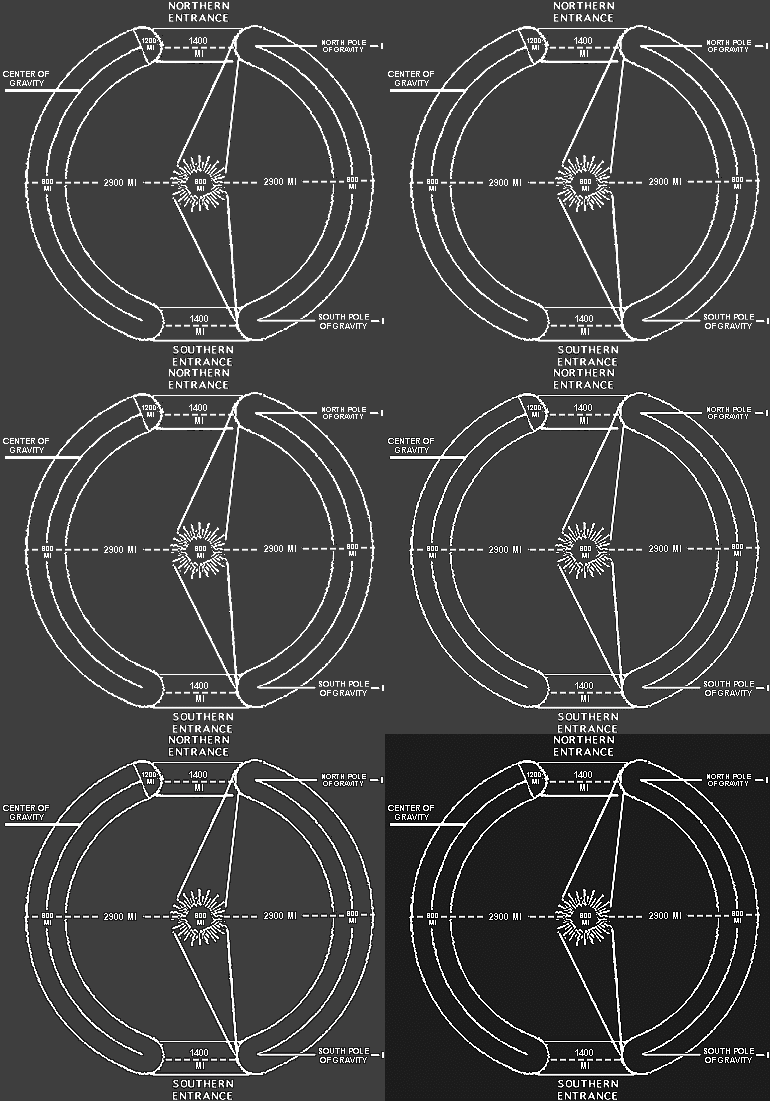
The crux of the hollow earth theory is that the earth is a shell with walls about
800 miles thick. In the polar regions there are holes 1400 miles across, with
edges that curve smoothly from the outside of the shell around to the inside. A
sea or surface traveler could proceed over an edge of the hole, like an ant
crawling over the lip of a coffee mug from the outside to the inside, and not be
aware that he was actually entering the interior of the earth. Bernard explains
that the holes have never been seen from the air because pilots are fooled by
their compasses into believing that they are crossing the pole, when they are
actually following the hole's "magnetic rim". Thus aircraft never really fly over
the geographic poles, which naturally mark the centers of the holes themselves.
As irrefutable proof of his claim, he cites Admiral Byrd's statement, "I'd like to
see that land beyond the Pole. That area beyond the Pole is the Great Unknown."
The hollow earth theory actually seems to have been originated in the early
1800s by John Symmes, an earnest American who devoted the greater part
of his later life to convincing the world that the earth was formed by a series of
concentric shells.
Symmes believed that there were miles of wondrous unclaimed domain beneath
our feet, with lush vegetation and fish and game for the taking.
Apparently, there were those who took him seriously. As reported in the October
1882 issue of Harper's New Monthly Magazine, a Mr. Howgate had recently been
in the news, proposing that an expedition be made to discover "Symmes' Hole."
His plan was to have a number of men acclimate themselves to higher and higher latitudes, moving further north each year. They were to observe the animals that
presumably wintered over within the earth each year and emerged during the
spring to bear young. Eventually, the colony of men were to follow the animals in
the fall to find where they entered into that marvelous land at the center of the
earth.
Sadly for this romantic concept, if today's believers are correct, the only thing that they would find there now are flying saucers.
|
For a long time I have been intrigued by the concept of the Hollow Earth.
I remember reading Raymond Bernard's book on the subject ( The Hollow
Earth -1979 ) in the mid 1980's and felt a strong affinity for the whole idea.
Next, I read a strange book called "Etidorhpa" by John Uri Llyod written in the late
1890's about a person who traveled from the Outer Surface to the Inner Surface
of the Earth and carrying when he arrived at the center of the Earth crust.
But before I lose our readers, let me define what the Hollow
Earth Theory states!
|
[ I too remember the Hollow Earth a polite way to think of the unthinkable Heaven on on earth albeit in the Earth No Mafia,CIA,Nazis,Landlords no Sushi,Movies ,TV ,Cell Phones no Money no birds on the wing no Rent no popcorn no Pizza no Porno no Junkies no Base Ball no jet planes no Bagles No Bacon no hot dogs no wild dog packs Rattlesnake dancers No Vargas Slots No Elvis no Pimps No Canadians ah! No Hockey no Enclave Cities No Subways no Circuus Clowns no Hot Rod's No Beer hey that sounds like Hell. No Beer that sucks & I don't even drink. ED]
 Just a dream of more "New World" with untold riches to Rip!Off!
|
According to Mr. Bernard (see diagram above) our world is hollow, with the
crust of the earth being 800 miles thick. There exists two openings at the North and
South Pole, each hole having a circumference of 1400 miles wide. At the
center of the earth is not a molten core but an inner sun which is six hundred miles
wide and is 2900 miles from the Inner Surfaces.
The diameter of the lip at the opening at the poles is 1200 miles long,
thus a person can not see the other side of the opening.
Therefore, there exists three worlds on our planet, the outer surface, where we live,
the middle earth which purportedly is lined with many caverns, tunnels (made by
someone), Inner Cities and people who live there and lastly the Inner Surface. How
Gravity [Must have been a really big deal to use that word GRAVITY ED] works then is
the following.
For the people who live on the outer surface,Gravity holds them down. For the
people that live in the middle earth, the closer they get to the center of the crust
(i.e. - 400 miles down), the less effect gravity will have upon them. In the book,
"Etidorhpa",when this individual traveling down into the earth reached the
center of gravity, i.e. where there is no gravity ---
he was able to move by the power of his mind, his heart stop beating and he didn't
need to eat. He described gigantic vegetation that lives under the earth as this lesser
pull of gravity allows things to grow larger. Lastly for the people who live on the inner
surface, they would also feel gravity pull on them to walk on this surface but since
there is an inner sun they would have sunlight 24 hours a day.
[in Alaska they grow giant vegatables du they say to the 24-7 Sun beating
down on the crops... I bet they'll grow as big as a mack truck with out all
of that peskey GRAVITY hua? ED]
There is supposedly land masses and water bodies that exist on the Inner Earth, the same as the outer surface except the vibration and energy in the Inner Earth is more
pure and of a higher vibrational frequency (some say a 4th dimensional frequency).
[Dont forget your Ear plugs...ED]
For people who have claimed to travel to the Inner Earth, they state that the people
they encounter in this region are usually very tall. Some other individuals have
speculated that descendants of Atlantis and Lemuria live in this Inner Utopia and
therefore they are thousands of years ahead of us technologically and spiritually.
[Yeah with all that Sunlight I bet they designed some reall cool sunglasses and can
read alot with out having to pay any electric bills...ED]
Some others say that possibly the Mayans may have gone into this location as well,
to explain where they disappeared. Again, according to our channeler Michael
Kant, he claims that 12 galactic races came to our Earth long ago and created
their first city underground in the 4 Corners area.
[That's the ticket call it a Theory it'll support more BS than a Carneys Barker right out of the "Hustler's Hand book" the #1 rule of adverting is "First get
there attention then Baffle them with Bull Shit!!" Swoop down and sell them Crystal Skulls With the DNA! Chip only 5 easy payments of $19.95+ shipping
& handling and of you order right now you will receive absolutely FREE an Easy Queasy Nose Picker, Ear Waxier combined Letter Openiner Yours to
keep! If You order right now. Our Operators are sweating for your call. You'll
be glad you did!! ED ]
Each race brought with them a crystal skull and body which contained the
gentic coding of their race and cosmic knowledge. Six tribes decided to
stay on the surface of the Earth and Six tribes went into the Inner Earth.
Now all twelve tribe exist in the Inner Earth. It is also believed that other
Extraterrestrial races may have bases in the Inner Earth as well.
Michael describes in our book being taken by a Pleiadian Space Ship and
given a tour of the Inner Earth.
In 1982, while traveling on faith throughout the western part of the U.S., I had the
fortune to meet Ed Palmer in Portland, Oregon, who is the founder of the
Cosmic Science Research Center.
Ed told us a very strange tale about how he was an exchange baby, that he was originally from Orion but when he was very small, the true Ed Palmer was exchanged
for him. He claimed that when he has had a physical examination that there are some
differences in his body and also that he has some type of mental plate in his head in which if a UFO comes close, he hears a buzzing sound. Even though Ed was in his
70's or 80's, he definitely had more energy and excitement of life than I at this time (being 27). In any case, Ed gave us a pamphlet that he shared with others about the
Hollow Earth.
In this pamphlet it said that all planets are Hollow (in Bernard's book, Mr. Bernard explains that what appears to be the pole cap we see of Mars, is actually
the light of Mar's inner sun shining out of the pole. Furthermore Bernard states
that the Aurora Borealis that is only visible up north is the reflection of the inner sun
off clouds passing over the opening of the pole.
Also that some explorers of the North Pole have discovered the closer they get to the Pole, the warmer it gets instead of the colder. Could the Mammoths discovered frozen
in Siberia with fresh food in their mouth be actually Mammoths that live in the Inner
Earth which has a warmer climate, and somehow got lost and wondered into the outer surface?) and that Ed even had a ride on a UFO to the moon which is hollow and that the ETs use the moon to construct spacecraft inside, hidden from our prying eyes.
Ed explains that when a planet is formed it is first just gas which is rotating.
He said that the heavy particles eventually expand out and create the planet's surface
and the lighter particles contract to form the central sun.
Another connection with the Inner Earth relates to Admiral Byrd. It is purported
that when the Admiral went to explore the North Pole that he actually entered into
the Inner Earth at the opening at this pole. Included below, you will see a purported
diary by Admiral Byrd that discusses he made contact with an advanced people
in this area who showed him their world and asked for him to take a message back
to the surface dwellers and government of their concern about a future vision they
had of our destroying our world and since this is their home as well, they of course
wanted to prevent this. If such a people do exist, it is theorized that possibly some
of the UFOs we see are not extraterrestrial but intraterrestials, as our elder
brothers keep an eye on us. It would require a spacecraft that can negate the force
of gravity to fly out ouf the Polar Openings as gravity would pull any boat or
airplane to follow the outer-to-inner surface. Another spiritual channel we have
been in communication with is Christine Hayes of the Star of Isis Foundation in
San Antonio, Texas. She claims to be receiving telepathic information from the
people who live in the Inner Earth.
|
Christine Hayes of the Star of Isis Foundation in San Antonio, Texas.
|
http://www.faqs.org/faqs/bodyart/piercing-faq/
http://www.americanpatrol.com/ vip
http://www.americanpatrol.com/CALIFORNIA/BUSTAMANTE/NaziCruzJTF-030924.html
Has he been revealed to you?
Will you RECIEVE his 6-6-6 Mark and go to HELL?
(1 of 6) [10/15/2003 1:25:12 AM].
Who is the Antichrist?
_As the World Socialist website has pointed out, when you add together the $368bn for routine spending, the $19bn assigned to the department of energy for new nuclear weapons, the $79bn already passed by Congress to fund
the war in Iraq and the $87bn that Bush has just requested to sustain it, you find that the US federal government is
now spending as much on war as it is on education, public
health, housing, employment, pensions, food aid and welfare put together.
World Socialist website
_________________________________________________________________
Hollow earth bullship = No Mafia,CIA,Nazies,Landlords no Sushi, Movies, TV ,Cell
Phones or Pizza. The Hollow Earth Theory is for sure 4 times winner idle prattle
of the week award...
Article #718 by Larry Gedney
 click on the picture http://www.alienshift.com/id52.html
How can you Pay the Explorer Dolphins with picture Cell-Phones
& credit card. Yeah the Planet Earth is a Gigantic Truffle with two
bung holes two oceans and two Suns and near zero "gravity",cool
|

How can you pay the explorer Dolphins with picture Cell-Phones
& credit card. Yeah the Planet Earth is a Gigantic Truffle with two
bung holes two oceans and two Suns and near zero "gravity",cool.
 |
The 20th Century has been a volatile and vastly variable epoch. It's myriad social, political and cultural
currents and countercurrents - it's ever increasing expansion of the 19th Century dialectic into manifold
polylectics - seem almost to cancel out one and another, leaving entropy as the net result.
Nevertheless, if one seeks not to summarize such an array of concepts and manifestations, the real
nature of the century comes forward. The aggregate character of the last 80-odd years is not just
unhomogenizable, it is anti-homogeneous.
The 20th Century is marked above all by variety, dissonance and the coexistence of what are in fact
mutually insupportable factors. Embodying this as an overriding aesthetic for our century is the method
of composition and communication variously called collage, montage, and nonsequitur. No matter the
form or medium of communication, this mode relies on disjuncture, rhythmic displacement, and the
confounding of expectation. Rules of verbal structure and narrative context are undermined and broken
outright in modern literature; the sequencing of events in drama and dance are reconsidered &
reconstituted; tonal harmonic relationships in music are destabilized and realigned; images in visual art
are formulated discontinuously & assume coherency in no previously logical way.
Basic perceptions and societal presumptions have thus been challenged constantly since the century
began. This collage aesthetic predominated in the most remarkable and influential art of the early 20th
Century expressly to challenge (and even pre-empt) the linear, progressive certainties on which earlier
social concepts were predicated.
Since the last world war the collage aesthetic has come to shape not just art, but most aspects of
communication, as montage-intensive media like cinema and radio have established themselves and
as montage-intensive formats like television have emerged to supersede even those.
Given this virtual redefinition of our society (most especially if "society" can be defined as a civilization's
common, or even communal self-perceptions) according to a grammar of fracture and disjuncture, the
importance of a collage aesthetic is self evident.
Indeed, it would not be unfair to regard the work of any modern, particularly postwar, artist as either
confirming or denying, celebrating or contradicting, the collage aesthetic. It would be wrong to fault
those artist whose homogeneity of image and method argues against the prevailing collage mode; in
emphasizing internal contradiction the collage aesthetic even incorporates the supposedly
contradictory idea of purity - overriding, however, any universal implication to which that idea might
pretend proposing instead a kind of "purity for awhile," as if the function of the purity concept were to
propose a (periodic cleansing). As such those artists who preach or practice coherence, uniformity,
and singularity of form, subject, or concept, play an important role - almost a religious one - in the
function of today's collage aesthetic.
Even so, those artists who consciously practice embodiments of the collage aesthetic are the ones
who speak directly to the current condition of Western civilization. Whether they reify, criticize or
parody this condition they concern themselves with actualities and probabilities drawn from there
given environment.
It is ironic to describe someone's thinking as "in tune" with an essentially dissonance-ridden world view,
but dissonance can be a form of consonance when its inherent patterns are grasped. Charles Mingus III
has grasped some of these patterns; having perceived what is inherent to the collage aesthetic, he has
developed modes of expression coherent to it. I emphasize the plural, modes of address; Mingus works
in at least two manners, manners which are related but are still quite distinct. This in itself indicates
Mingus' responsivity to the collage world view: his oeuvre displays a considered and controlled
inconsistency. On the one hand Mingus proposes a delicate world of beautiful abstract images,
satisfyingly geometric figures set in harmony with renditions of natural spaces (e.g. sea, sky, inscapes).
More frequently, however, Mingus sets aside this implosive formalism - which harks back to Rosenquist
& Rauschenberg, and even farther to the Jazzy figural tropes of Montparnasse Cubists like Gleizes &
depiction. This coherency, is the coherency of the collage aesthetic; it may suggest the veristic
rendition of earlier aesthetics, but in fact subverts that rendition with its jumps in context and
superposition of contexts. The jocular "Junior bird man" gesture which Pope John Pall II flashes at
photographers not long after his ascendance makes no "sense" ironic or otherwise, juxtaposed with
a picture of a chimpanzee, playing "ring toss" and feeding a porpoise against a noon time desert
landscape.
|
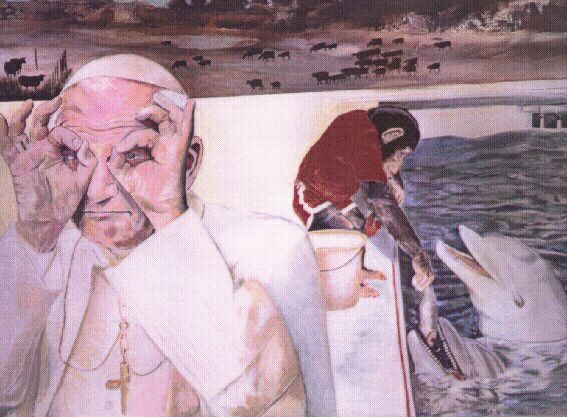 |
ANTHROPOMORPHICIAZATION OF TECHNO-POTPOURRI 2\23\83 ACRYLIC ON CANVAS 34"X46"
But Mingus places these disparate images in a relatively traditional, almost schematic foreground-
midground-background arrangement of fictive space. He thus forces these images to relate according
to traditional pictorial practices - or, conversely, he implies the obsolescence of such practices by
having them support a kind of visual free-association gibberish.
Interestingly, Mingus does not present these embodiments of the collage aesthetic as actual collages;
he paints and draws - freehand - from collages he constructs temporarily, destroying or filing them away
afterward with no thought to them as artworks in and of themselves.
This process of re-rendering does create a homogeneous texture which serves through contrast to
enhance the dissonance that exists between the images themselves.
Mingus' method recapitulates the homogenized texture provided (ironically) by television, cinema, and
the other inherently collaging montaging media - and, as in those media, Mingus' method exercises a
multivarent perception of reality that supplements the one point perspective traditional to Western
civilization.
~~~~~~~~~~~~~~~~~~~~~~~~~~~~~~~~~~~~~~~~~~~~~~~~~~~~~~~~~~~~~~~~~~~~
|
copyrighting numbers Date: Wed, 15 Oct 2003 07:56:01 -0700
Anyone interested in expressions of democracy and computers may find this thorough overview very interesting. The facts and figures have been bouncing around for awhile in different features, but The Independent, today, finally put many of them together on the front page online -- as the computerized revolution of US democracy. One of the more astonishing facts is that the voting systems and software solutions are protected by trade secrecy acts, making independent review and checking, well, a felony. And there are, in many cases, no paper trails or verifiable back ups. Anyone who has ever written a single line of logical code to run on an insecure computer would question the checks and balances -- and many computer scientists are doing just that, loudly. One line of audited code, lifted from an open FTP site used to distribute a patch for the deeply flawed Diebold (one of three major players) software, included an inexplicable instruction to divide the number of votes by 1. You do the math for 2004.
|